Vans
What size removal van do I need?
Volume is the number van hire sites advertise. Payload is the number that decides whether your move takes one trip or two, and it runs out first.
Answer a few questions and the price is yours in about two minutes — nothing to pay until you're happy with it.
Get my price 0191 743 2754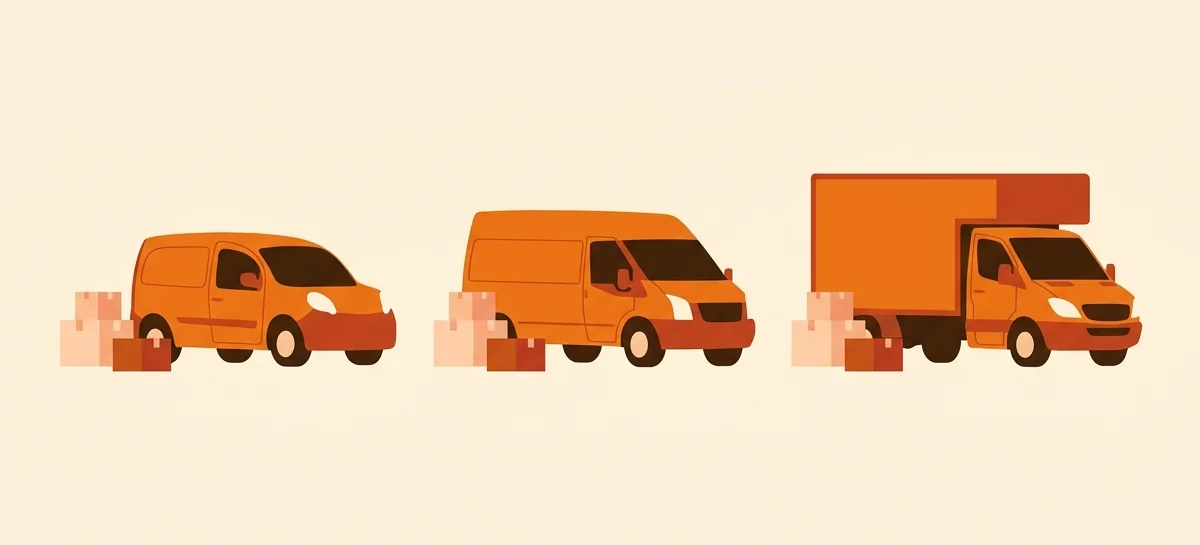
For most UK house moves the right removal van size is a 3.5-tonne Luton: about 22 cubic metres, and the biggest thing on a hire forecourt that a car licence covers. A one-bed flat goes in one load. A lightly furnished two-bed goes in one load if it is packed properly. A three-bed does not, nor a four-bed, whatever the hire desk tells you.
That is the size question answered. The more useful question, and the one almost nobody asks, is weight. Hire sites sell cubic metres because cubic metres sound generous. A Luton runs out of payload long before it runs out of space, and payload is what gets you stopped at the side of the A1.
Below: what each class really holds, room by room, what your licence covers, and where paying a firm starts costing less than a van and two days off. We run 3.5-tonne Lutons out of Durham, so these are the numbers we load to.
Start here: van size by what you are moving
What we would send, or what we would tell you to hire. “Loads” means round trips.
| What you are moving | Van you need | Load volume | Loads if you do it yourself |
|---|---|---|---|
| One or two items, or a car boot of boxes | Small van | 3–3.7 m³ | 1 |
| Studio or bedsit | SWB panel van | 5.8–9 m³ | 1–2 |
| 1-bed flat | LWB panel van or Luton | 11.5–22 m³ | 1 |
| 2-bed house | Luton | 22 m³ | 1 if lightly furnished, 2 if not |
| 3-bed house | Luton | 22 m³ | 2–3 |
| 4-bed house | Luton | 22 m³ | 3–4, or two vans running together |
Those counts assume you load the way hire customers do: sofa in first, gaps everywhere, nothing strapped. A crew stacking to the roof and filling the void over the cab gets a third more in per trip. Most of the difference between two loads and one. Square, same-size cartons stack into a wall; supermarket boxes and bin bags do not, which is the entire argument for packing boxes the way removal crews do.
The four van classes, in numbers that mean something
Hire firms use four names, and they mean the same thing everywhere:
| Class | Common vehicle | Load volume | Payload | What it takes |
|---|---|---|---|---|
| Small van | Ford Transit Connect | 3.1–3.7 m³ | 593–790 kg, diesels 722–772 kg | A large car boot. One sofa, or a washer and some boxes. |
| SWB panel van | Ford Transit Custom L1 | 5.8 m³ | around 1,100 kg | A studio, or one bedroom of furniture. |
| LWB panel van | Ford Transit 350 L3 H2 | 11.5 m³ | 1,322–1,419 kg | Best weight carrier here. A one-bed flat, comfortably. |
| Luton box van | Ford Transit 350 L4 Luton, tail lift | 22 m³ | 800–1,200 kg, as low as 690 kg on a heavy tail-lift build | Most space, least payload per cubic metre. Check the plate before you book one. |
Read those last two rows again. The Luton has nearly twice the space of the long-wheelbase van and less payload, not more: typically about three-quarters of it, and as little as half on a heavy tail-lift build. That is what a box body and a tail lift cost you in weight. It is why a move that is all books, tools and white goods sometimes wants the smaller van.
Payload is the number nobody checks
Every van has a maximum gross weight. Here it is 3,500 kg, and that covers everything: the van, its fuel, the driver, the passenger and every last thing in the back. Take away the empty van and what is left is your payload. On that Ford Luton: kerb 2,810 kg, gross 3,500 kg, payload 690 kg.
Now weigh a house. One Bosch 8kg washing machine is 68.5 kg on the manufacturer's own spec sheet. We tell customers to keep boxes under 18 kg so they can be carried up a staircase; at an average 15 kg, forty boxes is 600 kg. Forty boxes and that washer puts you at 668 kg of a 690 kg allowance, with the beds, the sofa, the wardrobe and the fridge freezer still in the hall.
Filling a van is easy. Knowing which items are dense, and calling it when a load has to be split, is what people pay us for without realising.
What a 3.5-tonne Luton holds
Ours measure 4.2 m long, 2.16 m wide and 2.29 m high inside, plus the box over the cab. That over-cab pod is roughly a metre deep and full height, it takes soft goods and nothing else sensibly, and it is the part every DIY load leaves empty. Filled properly, two people who do this daily get in:
- A three-seat sofa and a two-seat sofa
- A double bed frame, mattress and two bedside tables
- A single bed and mattress
- One double wardrobe, dismantled
- Two chests of drawers
- A dining table and four chairs
- Washing machine, fridge freezer and a television
- Forty to fifty boxes
That is a one-bed flat with room to spare, or a lightly furnished two-bed at a squeeze. It is not a three-bed house. Anyone telling you a single 3.5-tonne van clears a furnished three or four-bed in one go is either not counting the weight or has not seen the house.
Room by room, what each one costs you
- Living room: two sofas, a coffee table, a TV and a bookcase take about a quarter of the floor. The books are the problem. The densest thing in most houses, and they belong in small cartons, low down, spread across the width.
- Kitchen: washer, fridge freezer, microwave and eight to ten cartons of crockery and pans. Roughly a fifth of the space and closer to a third of the weight.
- One double bedroom: bed frame, mattress on edge down the side wall, two bedside tables, a dismantled double wardrobe, a chest of drawers and six to eight boxes of clothing. Clothing is all volume and no weight, so it goes over the cab.
- A second bedroom on top of that fills what is left of the floor and starts eating the over-cab space.
- Loft, garage and shed: where one load becomes two. A loft is bulky and light. A garage is the opposite. Tools, paint tins, paving offcuts and a lawnmower find your payload ceiling faster than the whole of the upstairs.
The order it goes in, and why that decides the load count
Heavy, square and low against the bulkhead first, spread across the full width so one side of the axle does not take it all. White goods stay upright. Mattresses and sofas travel on edge down the side walls, which is what buys back the floor. Boxes build a wall to the roof, heaviest at the bottom. Soft goods go over the cab. The last metre is left for whatever comes out of the house late, and something always does.
A load that finishes flat to the roof at the tail doors will not shift on the A167. A load with a metre of headroom over it is one that could have been a single trip.
What beats the van, whatever the cubic metres say
Some things are not a volume problem at all. These are the ones that change the plan:
- American-style fridge freezers. A two-person lift, wider than a standard doorway, and they take a corner of the load floor to themselves.
- Upright and grand pianos. Priced and crewed as a specialist job, not squeezed into a house load. Anyone quoting one casually over the phone has not moved many.
- Corner sofas. Measure the diagonal of your narrowest doorway, not the sofa. That is the measurement that fails, and usually on the way out rather than in.
- Safes, multigyms and treadmills. Dense enough that one item can be several percent of your payload.
- Books, tools, tiles, paint and garden bags. If two of those are in play, cut your box estimate.
- Anything you cannot get down the stairs at the far end. A Victorian half-landing in Durham beats a bigger van every time.
Stop guessing — get your actual price.A few questions, a fixed number on the spot, no phone call needed.
Get my priceOne load or two: the test we use before the day
Work in units. One unit is a bedroom in use, or a loft, garage or shed that is more than half full. Count the bedrooms you actually sleep in, not the ones on the floorplan.
- Two units or fewer: one Luton load.
- Three units: borderline. It depends entirely on how well it is packed.
- Four or more: two loads, or two vans running together.
- Then check the weight. Books, tools, paint, garden or gym gear in any two rooms and you drop a unit. You will hit the payload on the plate, whatever it turns out to be, long before you hit the roof.
On a local move a second run costs an hour and a half and some diesel. On a long run it is not an option at all: a North East to London removal is one load, loaded once and loaded right, or it is two vehicles and two crews. That is the real reason capacity planning matters more the further you are going.
What your licence lets you drive
A standard car licence (category B) covers any vehicle up to 3,500 kg maximum authorised mass with no more than eight passenger seats. Every hire Luton is built to sit exactly on that line, which is why the payload is so tight.
- Passed your test on or after 1 January 1997: 3,500 kg for the vehicle itself. Since the towing rules changed in December 2021 you can also tow a trailer up to 3,500 kg without taking a separate B+E test, provided vehicle and trailer together stay under 7,000 kg.
- Electric or hydrogen van: 4,250 kg, because the batteries are heavy and the rules allow for it. Add 750 kg again if it carries equipment for disabled passengers.
- Passed before 1 January 1997: older entitlements worth up to 8,250 kg for a vehicle and trailer combination. Plenty of people over fifty have never read the back of their photocard.
- Towing: category B pulls a trailer up to 3,500 kg, provided vehicle and trailer together stay under 7,000 kg.
What the licence does not do is make the van legal. You can hold a category B licence, hire a 3.5-tonne Luton, load it to 3.9 tonnes and be committing an offence the second the wheels turn. The licence limit and the weight limit are the same number, which is exactly why people confuse the two.
What happens when you are over the weight
DVSA weighs vehicles at the roadside. Penalties are graduated by how far over you are:
- Less than 10% over: £100 fixed penalty
- 10% up to 15% over: £200
- 15% and above: £300
- Over 30% over, or 5 tonnes of excess: a court summons instead
Examiners allow a 5% margin before acting, unless you are out by a tonne or more. The money is not what ruins the day. When a weight offence is issued, the examiner also stops the vehicle going any further. Your move is stationary on the hard shoulder until somebody takes weight off it.
There is a quirk in DVSA's own policy worth knowing. For non-commercial drivers it tells examiners that in genuine cases of ignorance. It names moving house specifically. A prohibition and a leaflet should be issued rather than a fine. So you probably will not be fined. You will still be sat on the verge with a van that cannot move.
Weight is not all they look at. The government's load securing guidance for goods vehicles (and a hire Luton is one) is blunt: restraint has to hold the entire weight of the load forward, and half its weight to each side and rear. A stack of boxes that looks stable on a driveway does not behave that way under emergency braking.
Two trips, a day off work, and where the maths turns
A Luton starts around £70 a day. That is the headline, not the bill. Typical terms give 100 miles a day then about 12p a mile once tax is on it, with a damage waiver charged on top, and you need to be 21 or over with twelve months' licence, a DVLA check code and two utility bills at the desk. Fuel is yours, as are blankets, straps and a sack barrow.
Then the clock. Two people who have never loaded a Luton take about four hours to fill one; two of ours take two. Unloading is quicker, call it two to three. On a Durham to Newcastle move, two loads is a fourteen-hour day once you add the driving and getting the van back before the desk shuts. Read how a moving day runs, hour by hour before you commit a Saturday to doing it twice.
So the real cost of a DIY two-bed is not £70. It is the van, the waiver, the mileage, the fuel, the materials you do not own and two people's working time. Ours is £370 for a local two-bed, fixed and in writing before anything is lifted. What removals really cost in the North East sets out the rest of it, and what moves the number. The gap is narrower than people expect, and it closes the first time somebody puts their back out on a divan base.
Stop guessing — get your actual price.A few questions, a fixed number on the spot, no phone call needed.
Get my priceWhen to hire the van, and when to ring us
Moving a studio three streets away, with a mate who has a strong back and a Saturday free, you should hire a small van. You will spend under a hundred pounds all in. Our man-and-van work carries a two-hour minimum, and you do not need two men for a bed and eight boxes. For that job we are the wrong call, and we will point you at a hire desk instead. The same goes for most single-room student moves in and out of Durham, where a hatchback and two runs beats anything with a tail lift on it.
Where we earn it is a full house, stairs at one end or both, a completion date that cannot move and no help arriving. A payload problem and an access problem at once. That is the point where choosing a removal company properly matters more than the size of the van on the drive.
If your life fits in one van load and you have two willing bodies, hire the van. If it takes two loads, hire a firm. Two DIY trips rarely comes out cheaper once you count the second day.
Two things about a big van that catch DIY movers out
A Luton is about 3.2 metres tall
Add the load floor height to the box and ours stand around 3.2 m. Multi-storey car parks, supermarket entrances and plenty of newer estate barriers stop at roughly 2 m. Check before the van is full, not while sat under a barrier with a queue behind you.
The Durham peninsula costs £5 a day
The Road User Charge Zone runs 10am to 2am, every day bar Christmas Day, Boxing Day and New Year's Day, enforced by ANPR where Silver Street meets Claypath. Pay within 24 hours or it becomes a £50 penalty. Moving to or from the Bailey or the Market Place, pay it the same day.
Still not sure? Give us the address
Tables get you close. A postcode, a bedroom count and one straight sentence about the loft gets you an answer. Tell us those three things and we will say whether it is one load or two, and price both. The Durham number gets you someone who loads these for a living.
Questions people ask
What size van do I need to move a 2-bedroom house?
A 3.5-tonne Luton, around 22 cubic metres. A lightly furnished two-bed goes in one load if it is stacked to the roof and the space over the cab is used. A fully furnished two-bed with white goods and a full garage is two loads if you are doing it yourself.
What fits in a 3.5-tonne Luton van?
Loaded by people who do it daily: two sofas, a double bed and mattress, a single bed and mattress, a dismantled double wardrobe, two chests of drawers, a dining table and four chairs, a washing machine, a fridge freezer, a television and forty to fifty boxes. That is a one-bed flat comfortably, or a lightly furnished two-bed at a squeeze.
Load volume or payload, which one should I go by?
Payload, almost always. A Luton advertises 22 cubic metres but typically carries 800–1,200 kg, and as little as 690 kg on a heavy tail-lift build, while a long-wheelbase panel van has half the space and around 1,300–1,400 kg of payload. If your move is books, tools, tiles and white goods you will hit the weight limit with the van half empty. If it is wardrobes, duvets and lampshades, volume is your limit.
Can I drive a 3.5-tonne Luton van on a normal car licence?
Yes. A category B car licence covers any vehicle up to 3,500 kg maximum authorised mass with no more than eight passenger seats, which is exactly what a hire Luton is built to. Electric and hydrogen vans go to 4,250 kg. The licence lets you drive it; it does not let you overload it.
How many boxes fit in a Luton van?
Space-wise, well over a hundred. Weight-wise, far fewer. At an average 15 kg a box, forty boxes is already 600 kg of a Luton's roughly 690 kg payload. Moving boxes and nothing else, an LWB panel van carries almost twice the weight.
Is it cheaper to hire a van or hire a removal company?
For one van load and two able bodies, hiring is cheaper: usually under a hundred pounds all in for a small van. For two loads it rarely is, once you add the damage waiver, the mileage, the fuel, the materials you do not own and two people's day off work. The turning point is the second trip, not the size of the house.
What happens if you overload a hire van in the UK?
DVSA issues graduated fixed penalties: £100 for less than 10% over, £200 up to 15%, £300 above that, and a court summons over 30%. More to the point, the examiner stops the vehicle going further until weight comes off. DVSA's own policy says private drivers caught while moving house get a prohibition and a leaflet rather than a fine. The van still cannot move.
How many trips does a 3-bed house take in a Luton?
Two, sometimes three if the loft and the garage are full. We build the second run into the fixed price before the day starts rather than adding it on the day, which is the difference between a quote and an estimate.
Sources
- GOV.UK — Driving licence categories — A category B car licence covers vehicles up to 3,500 kg maximum authorised mass with up to 8 passenger seats; 4,250 kg for zero-emission (electric or hydrogen) vehicles, with an additional 750 kg MAM where the vehicle carries equipment for disabled passengers; drivers who passed before 1 January 1997 are usually allowed a vehicle and trailer combination up to 8,250 kg MAM.
- GOV.UK — DVSA roadside checks: fines and financial deposits — DVSA graduated fixed penalties for excess weight: £100 for less than 10% over, £200 for 10% to under 15%, £300 for 15% and over; examiners allow a 5% leeway before issuing a fixed penalty or prohibition unless the relevant weight is exceeded by 1 tonne or more; when a fixed penalty is issued the examiner also prevents the vehicle going any further; a court summons is issued instead for overloads of 30% and over or excess weight of 5 tonnes.
- DVSA Enforcement Sanctions Policy — Section 10, Overloading — DVSA policy on non-commercial drivers: “In genuine cases of ignorance e.g. moving house, and where the offence is unlikely to be repeated, a prohibition should be issued, and an overloading guidance leaflet handed to the driver. To take into account the Public Interest Test no Fixed Penalty Notice should be issued in these circumstances.”
- GOV.UK — Securing loads on HGVs and goods vehicles: load securing basics — A load securing system on a goods vehicle must be able to withstand the entire weight of the load in the forward direction and half the weight of the load to the sides and to the rear.
- Dawsongroup Vans — Ford Transit 350 L4 Luton Van TL specification — Ford Transit 350 L4 Luton van with tail lift: gross vehicle weight 3,500 kg, kerb weight 2,810 kg, payload 690 kg, cubic capacity 22 m³, internal load length 4,219 mm, width 2,160 mm, height 2,287 mm.
- Van Reviewer — Ford Transit van weight and payload guide — Ford Transit 350 panel van payloads: L2 H2 1,379–1,472 kg, L3 H2 1,322–1,419 kg, L3 H3 1,277–1,374 kg; the guide states the best way to find a van's payload is to check the vehicle plate on the door pillar.
- Van Reviewer — Ford Transit dimensions — Ford Transit panel van load volumes: L2 H2 10 m³, L3 H2 11.5 m³, L3 H3 13 m³, L4 H3 15.1 m³; load lengths L2 2,946 mm, L3 3,494 mm, L4 4,217 mm.
- BAS World — Ford Transit Custom buying guide — Ford Transit Custom load volumes: 5.8 m³ for L1H1 and 6.8 m³ for L2H1, rising to 7.7 m³ and 9.0 m³ for the high-roof variants; payloads range from roughly 1,070 kg to 1,265 kg.
Keep reading
More moving tips
Ready to get moving?
Fixed price in two minutes. Date locked in three. Kettle packed last, obviously.
- Your price on screen before you hand over a phone number
- A real slot straight out of our live diary
- Save 5% online with the code BACKTOSCHOOL26 · online bookings only
- 30% deposit by Stripe · non-refundable · move your date for £25 with 72 hrs' notice
Rather talk it through? 0191 743 2754 · 8am–8pm, seven days a week